Understanding the evidence behind gene-disease or variant-disease associations is crucial for genomic research. The DISGENET Score (also known as GDA Score and VDA Score) helps you go beyond simply knowing that an association exists, providing a quantitative measure of the strength and reliability of evidence.
What is the DISGENET Score?
The DISGENET Score ranks gene-disease associations (GDAs) and variant-disease associations (VDAs) based on the confidence you can place in them.
It considers:
- Number of supporting sources
- Reliability of each source
- Number of publications reporting the association
- Type of evidence (human genetics, animal models, clinical studies)
This lets you quickly distinguish well-established associations from emerging, exploratory ones, so you can prioritize your research efficiently.
How is the DISGENET Score Calculated?
The score is a weighted sum of evidence components, where each component can contribute up to a maximum value. The stronger and more diverse the evidence, the higher the score.
GDA Score — five evidence components
Range: 0 to ~1.55 (higher scores indicate stronger evidence)
| Component | Sources | Max contribution |
|---|---|---|
| Curated | ClinGen, ClinPGX, ClinVar, GenCC, MGD, Orphanet, PsyGeNET, UniProt | ≤ 0.70 |
| Literature | Text-mined publications (human and model literature) | ≤ 0.40 |
| Inferred | GWAS Catalog, PheWAS Catalog, HPO, FinnGen, UK Biobank, ChEMBL | ≤ 0.25 |
| Clinical Trials | ClinicalTrials.gov | ≤ 0.10 |
| Models | MGD (mouse), RGD (rat), text-mined model literature | ≤ 0.10 |
VDA Score — three evidence components
Range: 0 to ~1.3 (higher scores indicate stronger evidence)
| Component | Sources | Max contribution |
|---|---|---|
| Curated | ClinGen, ClinPGX, ClinVar, GWAS Catalog, PheWAS Catalog, UniProt | ≤ 0.70 |
| Literature | Text-mined publications | ≤ 0.40 |
| Biobank | FinnGen, UK Biobank | ≤ 0.20 |
IMPORTANT: The score cap has been removed. The DISGENET Score was originally capped at 1. That cap is gone. Associations with exceptionally strong, multi-source support can now exceed 1 — GDA Scores reach up to ~1.55 and VDA Scores up to ~1.3. This preserves the full range of evidence rather than compressing the best-supported associations into a single value. If you need a strict 0–1 range for ranking or downstream analysis, use the Normalized Score (see below).
GDA Score Examples
Note: The examples below are for illustrative purposes only. DISGENET is updated regularly with the most up-to-date evidence, so GDA and VDA Scores and their underlying evidence change over time. These examples are intended to help you interpret the Score, not to provide current data.
LMX1B – Nail-Patella Syndrome (GDA Score = 1.2)
The association between the LMX1B gene and Nail-patella syndrome is a strong, well-supported association, with most of its confidence coming from expert-curated sources and reinforced by a large body of supporting literature.
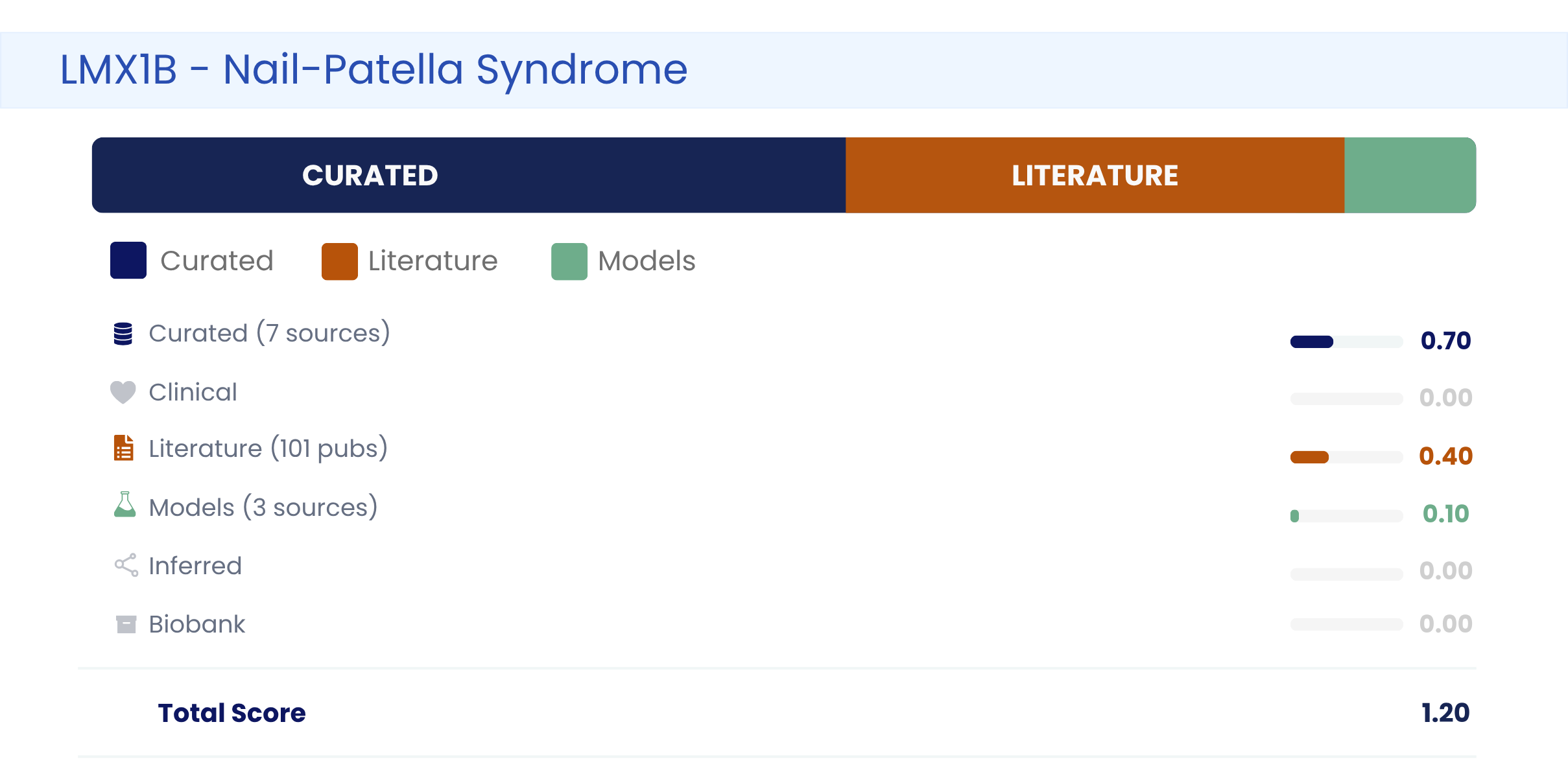
- High confidence: A GDA Score of 1.2 shows that this association is well-supported across multiple types of evidence, making it highly reliable for research or validation purposes.
- Evidence highlights: The majority of the confidence comes from curated sources (C = 0.7), showing strong expert validation, while the literature (L = 0.3) adds additional published support.
- Models and trials: Animal models contribute some support (M = 0.1), and clinical trials have not yet added evidence (T = 0).
WDR36 – Primary Congenital Glaucoma (GDA Score = 0.1)
To see how a low DISGENET Score looks in practice, let’s examine the association between the WDR36 gene and Primary congenital glaucoma. This association has a GDA Score of 0.1, indicating limited supporting evidence.
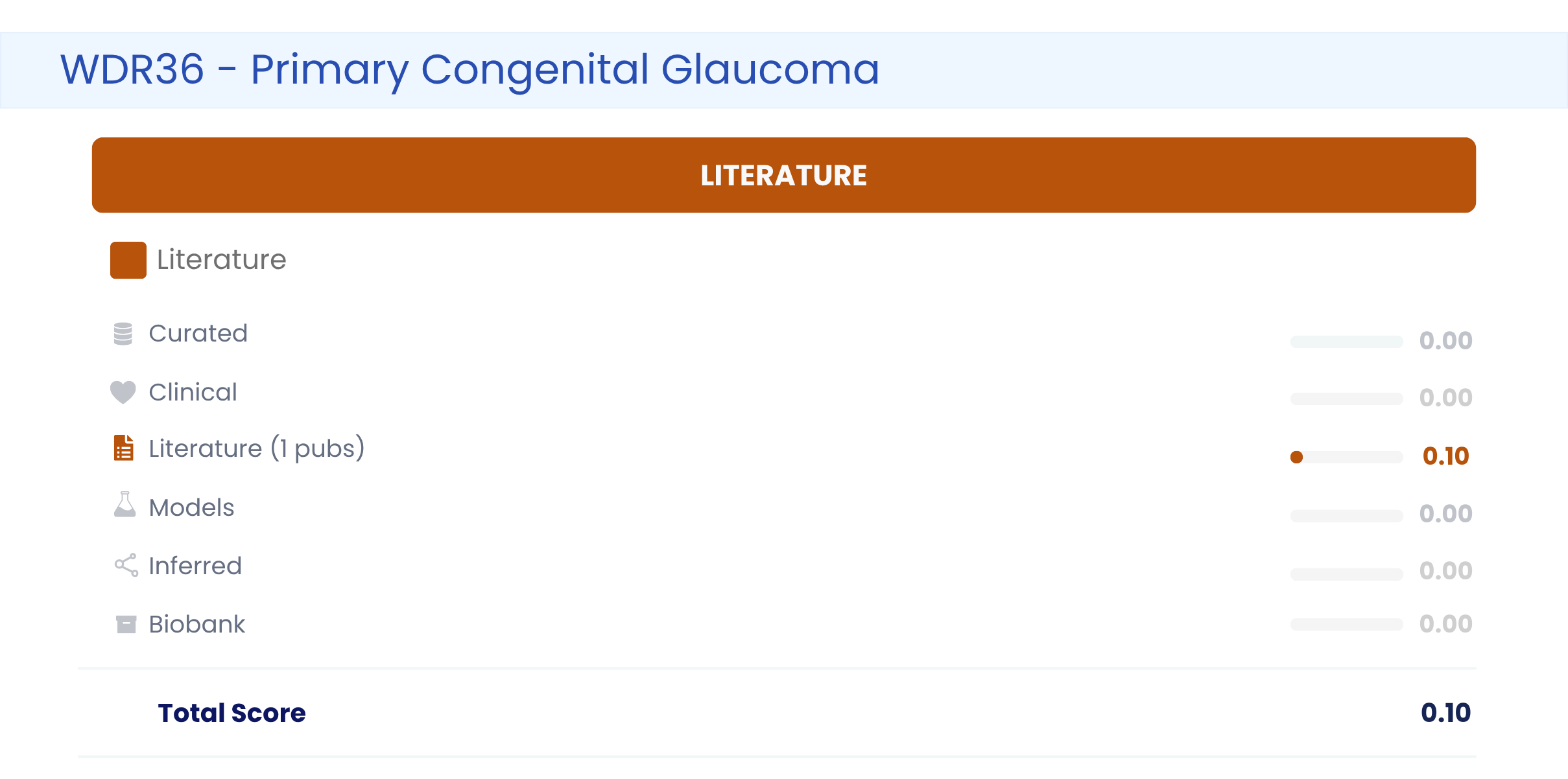
- Limited confidence: A GDA Score of 0.1 indicates that this association has very little supporting evidence and should be considered preliminary or exploratory.
- Evidence highlights: The only support comes from a single publication (L = 0.1), with no curated sources, animal models, inferred evidence, or clinical trials contributing.
- Research implication: Low-score associations like this can point to novel or underexplored links that may be worth further investigation in emerging research areas.
CARD10 – Primary Open-Angle Glaucoma (GDA Score = 0.5)
To illustrate a medium-confidence association, let’s examine the link between the CARD10 gene and Primary open-angle glaucoma. This association has a GDA Score of 0.5, reflecting moderate supporting evidence.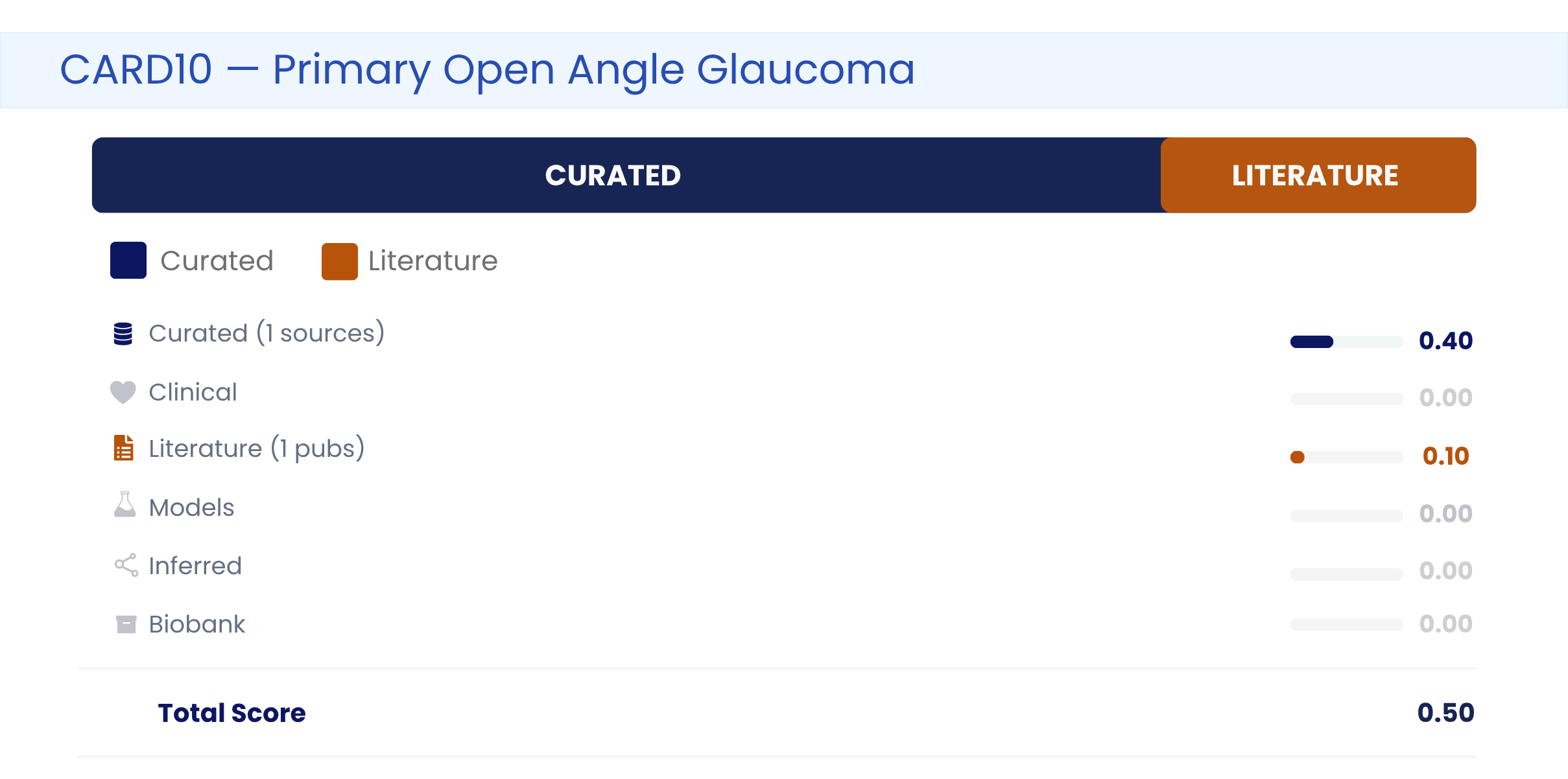
- Moderate confidence: A GDA Score of 0.5 indicates that this association has some supporting evidence.
- Evidence highlights: Most of the confidence comes from curated sources (C = 0.4), supplemented by a small number of publications (L = 0.1).
- Models and trials: No support is provided by animal models or clinical trials, so additional experimental or clinical validation may be warranted.
VDA Score
Like the GDA Score, the VDA Score evaluates variant–disease associations, with some differences in its components:
- Focuses on curated sources for reliability (up to 0.70).
- Integrates population-scale Biobank evidence from FinnGen and UK Biobank (up to 0.20).
- Incorporates text-mined Literature (up to 0.40).
Both GDA and VDA Scores let you prioritize the most reliable associations while still identifying novel research opportunities.
Related Scores
The DISGENET Score is your starting point, but it's part of a family of complementary metrics:
- Normalized Score — a min–max normalized version of the GDA/VDA Score, rescaled to a strict 0–1 range. Now that the cap has been removed, this is the recommended metric for ranking candidates and comparing associations across different diseases or genes. Available in the web interface, REST API, R package, Cytoscape App, and AIDA. See the score breakdown.
- My Score — a fully customizable score where you select preferred sources and assign your own weights. Available in the web interface (Standard & Advanced plans). See the score breakdown.
- Historical Score — recalculates the GDA Score using only evidence available within a selected year or range of years, letting you trace how an association's evidence has matured over time. Available in the web interface, REST API, R package, and AIDA. See the score breakdown.
Where to Find the DISGENET Score
The Web Interface
The GDA and VDA Scores are available directly in your search results. You can find them in:
- Summary Table: The first table displayed after typing your query into the search bar
- Evidence Table: The detailed table below the Summary table
Tip: The Score column is normally activated by default on the web platform.
If you don’t see the GDA or VDA Score in your table:
1. Click the “Select Columns” button above the table.
2. Select the checkboxes "ScoreGDA" or "ScoreVDA" to display the column.
You can also customize the table layout to make your workflow easier:
- Rearrange columns: Drag them left or right
- Lock important columns: Click the three lines icon on the column header and select “Pin to the Left/Right” to keep a column fixed in view.
For full details, see the metrics documentation.
Was this article helpful?
That’s Great!
Thank you for your feedback
Sorry! We couldn't be helpful
Thank you for your feedback
Feedback sent
We appreciate your effort and will try to fix the article